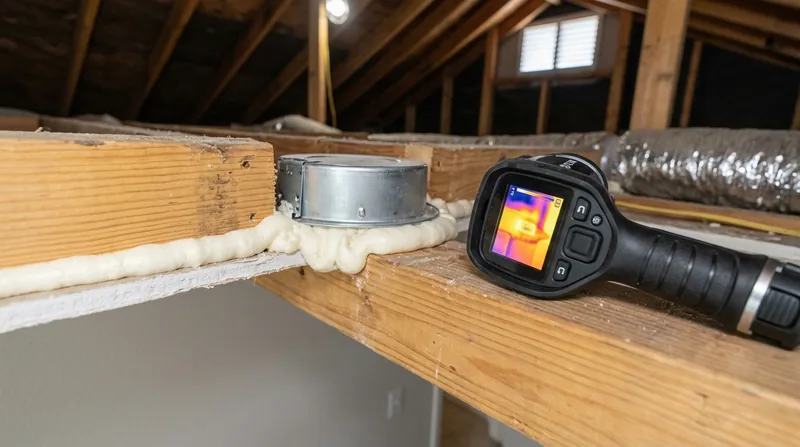




Fort Worth's climate and building stock make air sealing one of the most cost-effective comfort fixes in North Texas. Attics in this region routinely hit 140 to 160 degrees Fahrenheit during summer, and that heat radiates downward through every gap, crack, and unsealed penetration in the ceiling below. Top plates, can lights, attic hatches, and ductwork chases leak more cooled air than most homeowners realize, and sealing them before adding insulation is the difference between an R-value that performs and one that does not. Whether your home is a 1920s Craftsman bungalow in Ryan Place, a 1970s ranch in Wedgwood, or a newer two-story in Keller or Mansfield, the principle is the same: stop the air movement first, then insulate. We identify and seal these thermal leaks, then add attic spray foam insulation or other solutions that actually work because the air boundary is intact.
Why Air Sealing Matters in Fort Worth's Hot Attics
A vented attic in Fort Worth is a pressure cooker in summer. The ductwork that runs through it carries cold air from your air handler, and every unsealed joint, every gap around a light fixture, every crack at the top plate of your walls allows that cold air to escape directly into the attic instead of reaching the rooms below. In winter, warm air escapes the same way. The result is higher utility bills, uneven temperatures from room to room, and the constant feeling that your HVAC system is working harder than it should. Air sealing stops this leak before it starts, and the payback is immediate.
- We locate and seal penetrations where ductwork, plumbing, and electrical chases pass through the ceiling plane.
- We seal around recessed light fixtures, which are notorious sources of air loss in every attic we inspect.
- We seal the top plates of exterior walls, where the framing meets the attic space and conditioned air escapes directly.
- We seal attic access hatches and pull-down stairs, which leak as much air as an open window when left unsealed.
- We seal around soffit vents, ridge vents, and gable vents to prevent air from being drawn in uncontrolled during negative pressure.
Once these thermal leaks are sealed, every dollar you spend on insulation actually delivers the R-value you paid for.
Key info: A typical Fort Worth attic loses 20 to 40 percent of its cooled air through unsealed penetrations before it ever reaches your living space. Sealing these points costs a fraction of adding insulation and delivers results you feel immediately. See Energy Star's air sealing guidance for the science behind the savings.
How We Perform Air Sealing in Fort Worth Homes
Our process is systematic and thorough. We begin with a walkthrough of your attic to identify every significant air leak. We photograph the problem areas, take measurements, and explain what we find in plain language. Then we seal those penetrations using spray foam, caulk, or mechanical fastening, depending on the gap size and location. The work is done before we add any insulation, because an unsealed attic is like trying to fill a bucket with a hole in the bottom.
- We inspect the entire attic space, including the top plates of all exterior walls, soffit vents, and gable vents.
- We identify and mark every penetration where ducts, plumbing, electrical, or HVAC lines pass through the ceiling plane.
- We seal around recessed lights, attic access hatches, and exhaust fan ducts that connect to the outside.
- We use closed-cell or open-cell spray foam for large cavities and gaps, ensuring complete coverage and a continuous air barrier.
- We verify the seal visually and document the work with photos and a written estimate that specifies R-value and thickness.
Example: A 1960s ranch in Arlington with a vented attic had recessed lights throughout the ceiling, a pull-down staircase, and several ductwork chases. We sealed each light fixture with closed-cell foam, sealed the attic access hatch, and sealed all chases. The homeowner reported a noticeable temperature difference within days, and their summer utility bills dropped by 18 percent. That improvement came before we added any insulation.
Air Sealing Methods and When to Use Each
| Approach | Description | Best for |
|---|---|---|
| Closed-Cell Spray Foam | High-density foam with an R-value of 6 to 7 per inch; creates a continuous air and vapor barrier; requires mechanical ventilation during application. | Large cavities, rim joists, band joists, and attic chases where moisture control and structural support are priorities. |
| Open-Cell Spray Foam | Lower-density foam with an R-value of 3.5 to 4 per inch; air-sealing only, not a vapor barrier; faster cure and lower cost. | Attic penetrations, light fixtures, and wall cavities where air sealing is the goal and moisture is not a concern. |
| Caulk and Weatherstripping | Polyurethane or silicone caulk for small gaps; weatherstripping for moving parts like attic hatches and access doors. | Narrow cracks around framing, small pipe penetrations, and sealing attic hatches that need to open and close. |
| Mechanical Sealing | Rigid foam boards, backer rod, or metal collars installed around ducts and penetrations to block air movement. | Ductwork chases, soffit vents, and large openings where foam or caulk alone cannot provide adequate coverage. |
The choice of method depends on the size of the gap, the location, moisture exposure, and the R-value you need. We assess each penetration and recommend the most cost-effective solution for your home.
Air Sealing Cost in Fort Worth: What to Expect
Air sealing costs in Fort Worth typically start at $650 for a basic attic air sealing job, which includes sealing the top plates of exterior walls, attic access hatches, and the most obvious ductwork penetrations. The actual cost depends on the size of your attic, the number of penetrations, whether recessed lights are present, and the accessibility of the space. A larger home with more chases, more lights, and a complex attic layout will cost more than a simple ranch with a straightforward ceiling plane. We provide a written estimate that specifies what we are sealing, the materials we are using, and the R-value and thickness if spray foam is involved.
The best way to understand the cost for your home is to get an estimate. We recommend getting two or three quotes from local contractors so you can compare scope, materials, and pricing. When you review those estimates, look for specifics: which penetrations are being sealed, what material is being used, and whether the estimate includes a thickness specification and R-value. A vague estimate with no detail is a red flag. Our estimates are free and come with no obligation to book.
Visit our pricing page for more detail on what drives cost, and call us at (817) 607-8986 to schedule your free estimate. We can also discuss whether a closed-cell foam seal or a simpler caulk-and-weatherstrip approach is the right fit for your budget.
Air Sealing Near Me: What Fort Worth Homeowners Should Know When Hiring
When you are looking for an air sealing contractor in Fort Worth, Keller, Mansfield, or any of the surrounding areas, a few key things separate a thorough, honest job from a quick fix that does not last. First, verify that the contractor carries liability and property damage insurance and can provide a current certificate. Second, ask for an estimate in writing that specifies what is being sealed, the materials being used, and (if spray foam is involved) the thickness and R-value. Third, ask for references from recent jobs in your area, and do not be shy about calling them. Fourth, confirm that the contractor understands any local permit requirements for your city. Contractor registration and permitting rules vary from city to city across the Metroplex, and a contractor who does not know the rules for your address is not someone you want in your attic.
We operate in Fort Worth, Arlington, Keller, Southlake, Grapevine, Colleyville, North Richland Hills, Mansfield, Burleson, and surrounding areas. We are fully insured, we provide written estimates with material and R-value specifications, and we can explain what permits or registrations apply to your address. If you want to verify our standing or ask about our insurance, call us at (817) 607-8986 or contact us online. We have been in business since 2012, and we are happy to provide references and answer any questions before you book.
Air Sealing in Fort Worth: Pricing Guide
| Service | Price | Details |
|---|---|---|
| Basic attic air sealing | Starting at $650 | Sealing top plates, attic hatch, and primary ductwork chases; includes material and labor for typical single-story home |
| Air sealing with recessed lights | Starting at $950 | Sealing around multiple recessed light fixtures plus top plates and chases; cost increases with number of lights and attic complexity |
| Comprehensive attic air sealing | Starting at $1,400 | Complete sealing of all penetrations, lights, chases, soffit vents, and top plates; includes inspection, documentation, and written specification |
| Air sealing plus insulation | On estimate | Air sealing combined with spray foam or blown-in insulation; scope and material choice determined during on-site inspection |
| Travel and estimate | Included and free | No separate mileage fee within Fort Worth and surrounding service areas; free estimate provided within 24 hours |
Indicative pricing, the exact cost depends on square footage, finish, and site access. Free personalized estimate within 24h at (817) 607-8986.


