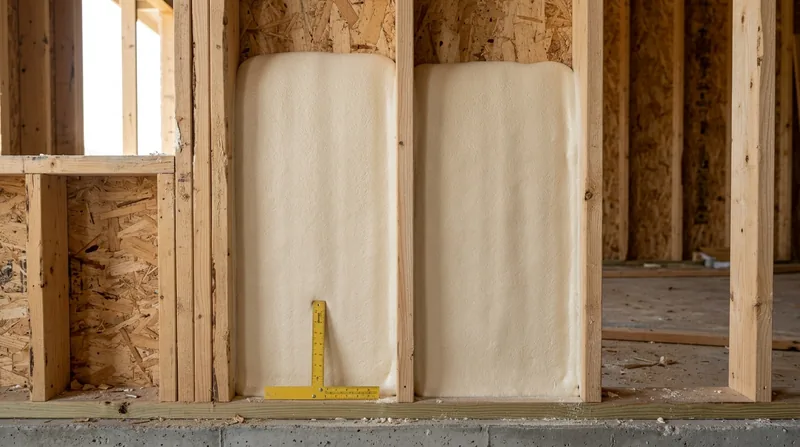




Closed cell spray foam insulation in Fort Worth solves a problem that defines the North Texas home: summer heat that climbs into the attic to 140-160 degrees Fahrenheit, winter freezes that burst water lines, and the structural demands of metal buildings and barndominiums that sweat without a vapor retarder. Two-pound closed-cell foam delivers R-6.5 per inch with its own moisture barrier and real structural stiffening, the right product for the pier-and-beam homes across Fairmount and Ryan Place, the brick two-stories in Keller and Southlake, and the metal shops and ranch buildings west of the city. Unlike open-cell foam or blown-in fiberglass, closed-cell gives you both insulation and air sealing in a single application, and it handles the temperature swings and humidity that come with living on the Grand Prairie. We have been doing this work since 2012, and we know how to spray it right: controlled thickness per pass, manufacturer ratio and drum temperature, mechanical ventilation during cure, and a stated re-entry window of twenty-four to forty-eight hours.
Why Closed Cell Spray Foam Matters in Fort Worth's Climate
Fort Worth sits in the heart of hail alley and on expansive clay soils where homes either sit on concrete slabs or on pier-and-beam foundations with open crawl spaces underneath. The ductwork and water lines run through a vented attic that becomes a furnace every summer, and the combination of extreme heat and hard winter freezes creates the exact conditions where closed-cell foam earns its cost. When you spray closed-cell into an attic, a metal building, a rim joist, or a wall cavity, you are not just adding insulation, you are creating an air barrier and a vapor retarder that stops moisture from condensing on steel or wood. That matters in August when the air conditioning runs eighteen hours a day, and it matters again in January when Winter Storm Uri sends ice into the attic.
- Closed-cell foam stops air leakage at the source, sealing gaps that fiberglass cannot reach and that blown-in insulation leaves open.
- The R-value of 6.5 per inch means you get the same thermal resistance as 10 to 12 inches of fiberglass in less than 2 inches of foam.
- At the thickness specified for the job, closed-cell foam also acts as a vapor retarder, which helps keep humid air out of wall and attic cavities.
- Closed-cell foam adds structural stiffness to metal buildings and barndominiums, reducing deflection and condensation on interior surfaces.
- The product meets code thermal barrier and ignition barrier requirements when applied correctly and inspected by the local building official.
For metal buildings, barndominiums, and any Fort Worth structure that has to handle both August heat and a hard freeze, closed-cell foam is the most cost-effective long-term answer.
Key info: Expansive clay soils in Fort Worth mean concrete slabs crack and pier-and-beam crawl spaces flood when water tables rise. Closed-cell foam on rim joists and band joists stops air infiltration and keeps cold air from reaching the living space above, a critical detail in a 1950s ranch in Haltom City or a new build in Walsh Ranch.
For more on how foam insulation works in attic and sealed roof deck applications, see our attic spray foam insulation service page.
The Texas Department of Licensing and Regulation does not issue a state license for insulation work, but your city may require contractor registration before any work begins. Ask any contractor for the registration your city requires and confirm it directly with your local building department before signing a contract. For Fort Worth specifically, contact the City of Fort Worth Development Services office to verify what applies at your address.
How We Install Closed Cell Spray Foam in Fort Worth
Closed-cell spray foam installation is not a quick afternoon spray. The product comes in two components that mix at the nozzle and cure in place, and the installation has to follow the manufacturer specification for thickness per pass, drum temperature, and ambient conditions. We move through the job in stages: first we inspect the attic, wall cavity, or structure for moisture, leaks, or contamination; if we find any, we address it or we walk away. Then we protect areas that should not get foam, set up mechanical ventilation to manage VOC off-gassing during cure, and spray the foam in controlled passes to build the specified thickness. We do not spray over wet substrates, and we do not promise immediate re-entry. The standard re-entry window is twenty-four to forty-eight hours, and we tell you that plainly when we give you the estimate.
- We inspect the site for moisture, roof leaks, or structural damage and address any issues before spraying begins.
- We set up mechanical ventilation to manage off-gassing and ensure safe conditions during the cure period.
- We spray closed-cell foam at the manufacturer ratio and drum temperature, building to the specified R-value and thickness in controlled passes.
- We trim excess foam and install thermal barriers or ignition barriers as required by code and the building official.
- We provide a written estimate that shows the R-value, thickness, and board footage so you know exactly what you are paying for.
The entire process, from inspection to trim-out, typically takes one to three days depending on the square footage and the complexity of the space.
Example: A 1,500-square-foot attic in Southlake with existing blown-in fiberglass and exposed ductwork takes two days: day one for inspection, ventilation setup, and the first pass of foam; day two for trim, thermal barrier, and cleanup. The homeowner stays out of the attic for forty-eight hours while the foam cures. By day three the attic is sealed and the cooling load on the air conditioning drops measurably.
For crawl spaces and rim joists, which are smaller and tighter, see our rim joist and band joist spray foam service page.
| Application | Description | Best for |
|---|---|---|
| Attic and Sealed Roof Deck | Closed-cell foam sprayed across the attic floor or under the roof sheathing to create a conditioned attic. Typical depth 4 to 6 inches for R-26 to R-38. | Homes with ductwork in the attic, vaulted great rooms, or bonus rooms that need year-round climate control. |
| Wall Cavity Retrofit | Closed-cell foam injected into empty wall cavities of pre-1980 homes without removing drywall. Typical depth 3.5 to 5.5 inches for R-23 to R-36. | Brick veneer ranches in Haltom City and North Richland Hills where original fiberglass has settled or is missing. |
| Rim Joist and Band Joist | Closed-cell foam sprayed on the rim board and band joist of pier-and-beam homes to stop air leakage and moisture infiltration from the crawl space. | Craftsman bungalows in Fairmount and Ryan Place, and any pier-and-beam home over an open or partially vented crawl space. |
| Metal Building and Barndominium | Closed-cell foam sprayed on the interior of metal roof decks and walls to control condensation and provide insulation. Typical depth 2 to 4 inches for R-13 to R-26. | Horse barns, agricultural shops, and barndominiums in Parker and Hood County where condensation on steel is the primary failure mode. |
| Crawl Space Encapsulation Support | Closed-cell foam sprayed on rim joists and band joists as part of crawl space moisture control. Foam alone is not a full encapsulation but a critical component. | Homes where moisture is rising from the crawl space and open-cell foam or fiberglass would absorb water. |
Closed Cell Spray Foam Insulation Cost in Fort Worth: What to Expect
Closed-cell spray foam pricing starts at approximately $1.20 per board foot installed, though the final cost depends on the size of the space, the thickness needed for your R-value target, access to the work area, and whether you need existing insulation removed first. A typical 1,500-square-foot attic sprayed to R-30 (approximately 5 inches of closed-cell foam) runs between $4,500 and $7,500 depending on the condition of the existing insulation and the complexity of the space. Wall cavity retrofit in a pre-1980 home costs less per square foot because the cavities are smaller and the foam depth is shallower. Metal buildings and barndominiums are priced by the square footage of the roof or wall surface, and condensation control on steel often needs less foam depth than attic insulation does, so the cost per board foot is lower but the total project may still be substantial because the surface area is larger.
Factors that move the cost up or down include the need to remove and haul away existing insulation (which adds labor and disposal fees), the accessibility of the work area (tight crawl spaces take longer), whether you need thermal barriers or ignition barriers installed per code, and travel distance within Fort Worth and the surrounding areas. We include travel in Fort Worth, Arlington, Keller, Southlake, Grapevine, Colleyville, North Richland Hills, Mansfield, Burleson, Benbrook, Weatherford, Hurst, Euless, Bedford, Granbury, Cleburne, Saginaw, Azle, Grand Prairie, and Aledo, so there is no separate mileage fee.
The best way to get an accurate price is to request a free estimate. We will inspect the space, measure the square footage, discuss your R-value target, and give you a written estimate with the board footage, thickness, and total cost spelled out. That estimate is free and there is no obligation to book. Call us at (817) 607-8986 and we will respond within 24 hours.
For a full pricing overview and examples of other services, see our pricing page.
Closed Cell Spray Foam Insulation Near Me: What Fort Worth Homeowners Should Know When Hiring a Contractor
Hiring a spray foam contractor is a commitment that will affect your home's comfort and energy bills for years, so it is worth taking time to find the right one. The spray foam market in North Texas includes local independent shops, national franchises, and rig-and-run crews that show up, spray, and disappear when the smell will not go away or the foam does not cure properly. When you are comparing contractors, here is what to look for and what to ask.
- Ask any contractor whether your city requires contractor registration and ask them to show you proof of registration before you sign a contract.
- Confirm that the contractor is fully insured and ask for a certificate of insurance naming you as an additional insured during the work.
- Request a written estimate that shows the R-value, thickness in inches, board footage, and total cost, not just a price per square foot with no detail.
- Ask about the re-entry window and mechanical ventilation during cure; if a contractor promises immediate re-entry or no smell, that is a red flag.
- Get references from recent jobs in your area and call them; ask whether the foam cured properly, whether there were any odor issues, and whether the contractor was responsive after the job was done.
- If your home is in a historic district or an HOA with architectural rules, confirm that the contractor understands what permits or approvals are needed before work begins.
We have been doing this work since 2012 and we are fully insured. We give you a free estimate within 24 hours, and we stand behind every job we spray. Contact us today to schedule your estimate.
Closed Cell Spray Foam Insulation in Fort Worth: Pricing Guide
| Service | Price | Details |
|---|---|---|
| Attic Spray Foam | Starting at $1.20/board ft | Two-pound closed-cell foam, R-6.5 per inch, includes inspection, ventilation, and thermal barrier per code |
| Wall Cavity Retrofit | Starting at $1.20/board ft | Closed-cell foam injected into empty cavities of pre-1980 homes, no drywall removal needed, includes hole patching |
| Metal Building or Barndominium | Starting at $1.20/board ft | Two-pound closed-cell on interior of roof decks and walls, controls condensation, includes mechanical fastener or adhesive per code |
| Rim Joist and Band Joist | Starting at $1.20/board ft | Closed-cell foam on pier-and-beam rim boards, stops air leakage and moisture infiltration from crawl spaces |
| Insulation Removal and Replacement | On estimate | Removal and disposal of existing fiberglass or blown-in insulation, plus new closed-cell foam, requires site inspection |
| Estimate | Free | Response within 24 hours at (817) 607-8986, includes R-value and thickness specs, no obligation to book |
Indicative pricing, the exact cost depends on square footage, finish, and site access. Free personalized estimate within 24h at (817) 607-8986.


