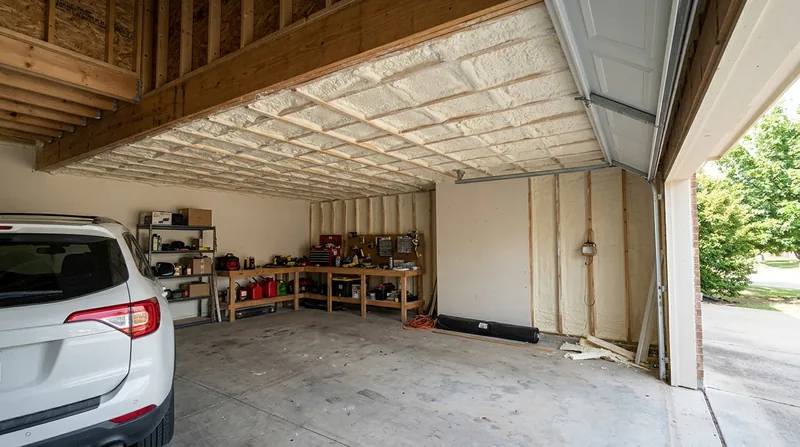




Garage spray foam insulation in Fort Worth transforms a storage oven into usable workshop or bonus room space. Fort Worth summers push attic and garage temperatures past 140 degrees for weeks at a time, and an uninsulated garage ceiling under a second story becomes a radiant heat sink that bleeds into living spaces above and makes the garage itself uninhabitable during the day. Spray foam seals the ceiling and shared walls against that afternoon load, stops air leakage at the rim, and holds the temperature differential steady enough to reclaim the space. Whether you are finishing a workshop, converting a storage area, or simply protecting the room above from the heat gain below, the difference is measurable and immediate. We have been sealing garages across Fort Worth and Arlington since 2012, and we start every job with a clear estimate that names the R-value, thickness, and material we will use.
Why Garage Spray Foam Insulation Matters in Fort Worth and North Texas
A standard Fort Worth garage sits unvented below a bonus room, guest suite, or primary bedroom. The concrete slab radiates heat, the ceiling and walls leak air, and the space above bakes in afternoon sun. Closed-cell spray foam on the garage ceiling and the shared wall with the house creates an air seal and a thermal break that protects the conditioned space upstairs and makes the garage itself usable for a workshop, gym, or storage without turning it into a heat chamber. The return on that foam shows up in utility bills, in the livability of the room above, and in the resale value of the home.
- Stops radiant heat transfer through the ceiling from the attic space above the garage into the room above.
- Seals air leaks around the rim where the garage wall meets the house framing, cutting infiltration from the unconditioned space.
- Protects the room above from temperature swings that make it uncomfortable in summer and cold in winter without constant thermostat adjustment.
- Allows the garage itself to be finished or converted to workshop space that stays within 10 to 15 degrees of outdoor temperature without mechanical cooling.
- Adds structural rigidity to the ceiling and reduces vibration and sound transmission from the garage into the living space.
In neighborhoods like Wedgwood, Ridglea, and across the newer subdivisions of Keller and Southlake, a finished bonus room or guest suite over a garage is the high-value addition, and a poorly insulated ceiling is the weak point that kills the investment.
Key info: A garage ceiling under a bonus room in Fort Worth can hit 160 degrees in July. Closed-cell spray foam holds that heat outside the room above, and the air seal stops the convection that makes standard fiberglass fail. The difference is not theoretical; homeowners report a 15 to 20 degree temperature drop in the room above after foam is installed.
For detailed guidance on contractor credentials and permitting in Fort Worth, consult the City of Fort Worth Permits and Inspections office, which governs all contractor registration and building permits in the city.
How We Seal and Insulate Your Garage Ceiling and Walls
The work starts with a site visit to measure the ceiling and walls, identify air leaks around rim joists and wall penetrations, and confirm the substrate is clean and dry. We then move through a step-by-step process that ensures the foam bonds correctly, cures without off-gassing into the home, and delivers the R-value promised in the estimate. Mechanical ventilation during cure is standard, and we do not allow re-entry until the foam has fully cured, typically 24 to 48 hours depending on conditions.
- We measure the ceiling and walls, identify all rim joists, band joists, and air leak pathways that run into the conditioned space.
- We prepare the substrate by cleaning debris, sealing large gaps, and confirming the surface is dry and ready to bond foam.
- We spray closed-cell foam in controlled passes, building thickness to the R-value specified in your estimate, typically R-15 to R-30 for a garage ceiling.
- We trim excess foam flush with the framing and install the thermal and ignition barrier required by the energy and building code in your city.
- We run mechanical ventilation during cure and provide a re-entry window in writing so you know when the space is safe to use.
- We walk you through the finished installation and answer questions about maintenance and the warranty on our work.
A typical garage ceiling in a Mansfield or Burleson home takes 6 to 10 hours of work spread over two days to allow proper cure time. If you are also sealing the rim and band joists where the garage wall meets the foundation, we handle that in the same visit and often find it reduces air infiltration more than the ceiling alone.
Real example: A Keller homeowner finished a garage workshop for woodworking. The original fiberglass batts in the ceiling were compressed and had gaps around the rim. After we sprayed closed-cell foam at R-20 on the ceiling and sealed the rim joist, the workshop stayed usable during summer heat without a separate AC unit, and the utility bill for the room above dropped noticeably. The air seal was the bigger win than the R-value alone.
Garage Spray Foam Insulation Methods and Materials
| Approach | Description | Best for |
|---|---|---|
| Closed-cell spray foam | High-density foam (3.5 to 4 lbs per cubic foot) that creates an air barrier and moisture barrier. R-value is approximately 6 to 6.5 per inch. Low permeability stops vapor transmission and condensation on metal studs or in humid conditions. | Garage ceilings under conditioned space, shared walls with the house, and any application where air sealing and moisture control are priorities. Most common choice in Fort Worth for this application. |
| Open-cell spray foam | Lower-density foam (0.5 to 1 lb per cubic foot) with an open cell structure. R-value is approximately 3.5 to 3.8 per inch. Vapor-permeable, so moisture can dry through the foam. Typically lower cost than closed-cell. | Garage ceilings where budget is a constraint and the substrate is dry. Not recommended for rim joists or walls shared with the house because the air seal is less complete and moisture control is weaker. |
| Ceiling only with rim joist sealing | Foam applied to the garage ceiling and the rim joist and band joist where the wall meets the foundation or slab. Stops both radiant heat and air infiltration at the two largest leak points. | Most effective for protecting a room above and for finishing the garage as usable space. Addresses both heat and air leakage. |
| Full wall and ceiling insulation | Spray foam applied to the ceiling, the shared wall with the house, and all rim and band joists. Creates a complete thermal and air barrier around the garage. | Garage conversion to workshop, gym, or guest space where temperature stability and noise reduction are important. Highest cost but delivers the most complete performance. |
Garage Spray Foam Insulation Cost in Fort Worth: What to Expect
The cost of garage spray foam insulation in Fort Worth depends on the size of the ceiling, whether you are also sealing walls and rim joists, the R-value you choose, and the access to the space. A typical garage ceiling ranges from 400 to 600 square feet, and the material, labor, and thermal barrier bring a closed-cell foam job to a starting point of around $1,200 to $2,000 for a basic ceiling. If you add the shared wall with the house and the rim joist sealing, the scope grows and the cost moves up accordingly. Every estimate includes the R-value, thickness in inches, and the material type so you know exactly what you are paying for.
Factors that affect the final price include the height and pitch of the ceiling (harder access costs more labor), whether the substrate requires cleaning or repair before foam can be applied, the complexity of the rim joist detail, and whether you are combining this work with attic spray foam insulation in the same visit. We always provide a written estimate with no obligation, and we encourage you to get 2 to 3 estimates from different contractors so you can compare scope, R-value, and price side by side. The cheapest estimate is often the one with the fewest details and the highest risk of problems later.
For a detailed pricing overview and to see how different scope levels compare, visit our pricing page. A free estimate is always the first step, and we respond within 24 hours at (817) 607-8986.
What to Look for When Hiring a Garage Spray Foam Insulation Contractor Near Me in Fort Worth
The spray foam insulation market in Fort Worth includes local independents, national franchises, and rig-and-run crews that spray a job in an afternoon and disappear. The difference between a contractor you can trust and one you should avoid comes down to how they estimate, how they work, and whether they are reachable after the job is done. A professional contractor provides a written estimate with R-value and thickness, runs mechanical ventilation during cure, and offers a workmanship warranty of at least one to three years. A cheap estimate with no details, a promise to re-enter the space immediately, and an insurance certificate you cannot verify are red flags.
- Ask any contractor for proof of general liability insurance and verify the policy is current and covers spray foam work.
- Request a written estimate that specifies the R-value, thickness in inches, the foam type (closed-cell or open-cell), and the thermal barrier method.
- Confirm that the contractor understands the permitting and building code requirements for your city (Fort Worth, Arlington, Keller, or wherever your address is), and defer to the local building official on thermal barriers and ignition barriers.
- Ask about the contractor's experience with garage insulation specifically, and request references from homeowners who had similar work done in the past two years.
- Verify that the contractor will run mechanical ventilation during cure and provide a written re-entry window so you know when the space is safe to use.
- Confirm that any HOA architectural rules for your neighborhood do not restrict exterior work, and understand that interior garage work is not typically subject to HOA approval.
When you are ready to move forward, contact us for a free estimate. We provide a detailed scope, clear pricing, and a timeline before we start any work, and we are available throughout Fort Worth and surrounding areas.
Garage Spray Foam Insulation in Fort Worth: Pricing Guide
| Service | Price | Details |
|---|---|---|
| Garage ceiling only, closed-cell foam at R-20 | Starting at $1,200 | 400 to 500 square feet, includes material, labor, thermal barrier, and mechanical ventilation during cure |
| Garage ceiling plus shared wall with house | Starting at $1,800 | Adds approximately 150 to 200 square feet of wall area, increases air seal effectiveness and heat protection significantly |
| Ceiling, walls, and rim joist sealing | Starting at $2,400 | Complete thermal and air barrier around the garage, addresses both radiant heat and infiltration, most effective for finished space |
| Large garage or complex scope | On estimate | Three-car garages, vaulted ceilings, or additional wall penetrations require on-site measurement and scope review before final price |
| Travel and site visit | Included | No separate travel fee or mileage charge within Fort Worth and surrounding service areas |
| Free written estimate | No charge | Response within 24 hours at (817) 607-8986, includes R-value, thickness, material type, and scope details |
Indicative pricing, the exact cost depends on square footage, finish, and site access. Free personalized estimate within 24h at (817) 607-8986.


