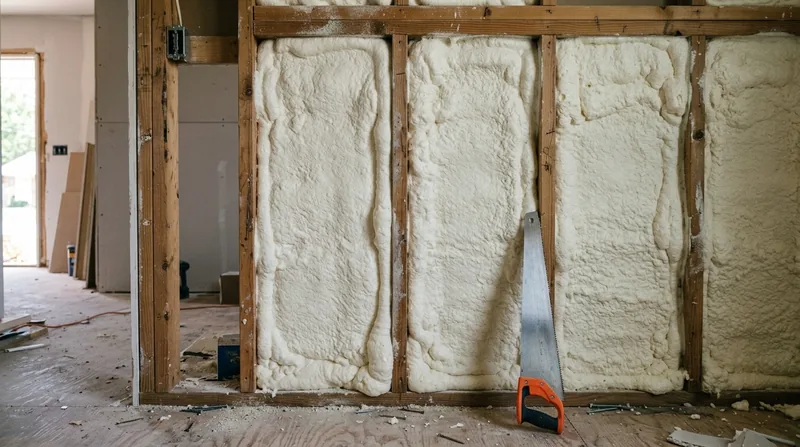




Open Cell Spray Foam Insulation in Fort Worth is the cost-effective answer for homeowners looking to seal attics, walls, and vaulted spaces without the premium price tag of closed-cell foam. Fort Worth sits on the rolling Grand Prairie where summer attic temperatures routinely hit 140 to 160 degrees Fahrenheit, and homes here run the full spectrum: 1900s Craftsman bungalows on pier-and-beam over open crawl spaces, 1950s-70s ranches with empty wall cavities and flattened attic fill, and modern brick two-stories with vaulted great rooms and bonus rooms that demand air sealing at every transition. Half-pound open-cell foam air-seals those cavities and attic bypasses at roughly half the cost per board foot of closed cell, adds sound dampening between rooms as a bonus, and works beautifully in Fort Worth's climate where moisture is not the driving failure mode. We spell out where open cell belongs, and where a sealed crawl space, a metal building, or a pier-and-beam floor calls for closed cell instead. Call us at (817) 607-8986 for a free, no-obligation estimate, or visit our homepage to learn more about our full range of spray foam and air sealing services.
Why Open Cell Spray Foam Insulation Matters in Fort Worth's Hot, Vented Attics
The dominant attic failure in Fort Worth is not moisture or condensation, it is uncontrolled air leakage in a vented attic space that sits 140 to 160 degrees in summer and runs ductwork, water lines, and electrical chases through it. Open-cell foam seals those bypasses and cavities without the cost of closed-cell density. It also absorbs sound between rooms, a real benefit in two-story homes with great rooms and bonus spaces where noise travels through open framing. For most attics in Wedgwood, Ridglea, Arlington Heights, and the 1990s-2020s subdivisions of Keller, Southlake, and Mansfield, open cell is the right choice and the smart budget.
- Open-cell foam fills cavities and seals air leaks at roughly 50 to 60 percent of the cost per board foot of closed-cell foam.
- It provides sound dampening between floors and rooms, reducing noise transmission in vaulted and multi-story spaces.
- It cures to a soft, permeable foam that allows any residual moisture in vented attics to pass through without trapping it.
- It reaches an R-value of approximately 3.5 to 3.7 per inch, sufficient for attic top-up and cavity fill in North Texas heating and cooling loads.
For homeowners choosing between open and closed cell, the question is use: sealed crawl spaces, metal buildings, and rim joists need closed cell to control condensation; vented attics in Fort Worth need open cell to seal air leaks at a reasonable cost.
Key info: A 1,200-square-foot attic in a Keller or Southlake ranch, topped up with 5 inches of open-cell foam over existing fiberglass, typically runs 6,000 to 7,500 board feet and costs $3,300 to $4,500. The same attic in closed cell would run $6,500 to $8,500. Both seal the space; open cell is the practical choice when the attic is vented and dry.
For more detail on how closed cell works in sealed attics and crawl spaces, see our page on Closed Cell Spray Foam Insulation.
How We Install Open Cell Spray Foam Insulation in Fort Worth Attics and Walls
Open-cell foam is sprayed from a heated rig in two-pass applications: the first pass fills the cavity to 90 percent; the second expands and hardens it to the target thickness. We work from the attic floor up, or from the wall cavity inward, always with mechanical ventilation running during the spray and cure phases. Proper drum temperature, hose ratio, and pass control are the difference between a silent install and a home that smells for months. We set a re-entry window of 24 to 48 hours depending on humidity and temperature, and we do not promise immediate occupancy.
- We inspect the attic or wall cavity for air leaks, moisture, and substrate condition before any foam is mixed.
- We set up mechanical ventilation and containment to direct fumes out of the home during spray and cure.
- We spray open-cell foam in controlled passes, building thickness to the specified R-value and coverage.
- We document the job with R-value, thickness, and board-foot total in a written estimate and final report.
- We schedule a re-entry window and explain the curing process and any temporary odor to expect.
The process is straightforward, but the details, drum temperature, nozzle pressure, ambient humidity, pass timing, determine whether the foam cures silent or smells for weeks.
Example: A 1950s ranch in Fort Worth with a vented attic and original fiberglass that has settled to R-11 needs a 5-inch top-up of open-cell foam to reach R-25 total. We spray the entire attic floor at 5 inches, seal the rim board and band joist where the wall meets the attic floor, and air-seal around ductwork penetrations. The job takes 8 to 10 hours, requires 24 to 48 hours for full cure, and costs $3,300 to $4,200 depending on attic square footage and access.
For information on wall and injection foam retrofit in older Fort Worth homes, visit our Wall & Injection Foam Insulation page.
Open Cell vs. Closed Cell: When to Use Each in Fort Worth
The choice between open and closed cell is not a brand preference or a contractor opinion, it is driven by the job itself. Open cell seals vented attics and interior cavities in dry climates; closed cell controls condensation in sealed crawl spaces, metal buildings, and unheated rim joists. Fort Worth's attic failure mode is air leakage in summer heat, not moisture, so open cell is the standard choice. But if you are sealing a crawl space, a metal building, or a pier-and-beam floor joist where condensation is the enemy, closed cell is the only answer.
| Approach | Description | Best For |
|---|---|---|
| Open-Cell Spray Foam | Half-pound density, R-value 3.5 to 3.7 per inch, permeable, sound-dampening. | Vented attics, interior wall cavities, bonus rooms, sound control in two-story homes. |
| Closed-Cell Spray Foam | Two-pound density, R-value 6.0 to 6.5 per inch, vapor barrier, moisture control. | Sealed crawl spaces, metal buildings, rim and band joists, unheated garages, condensation control. |
| Open-Cell Top-Up Over Fiberglass | 3 to 6 inches of open-cell foam over existing settled fiberglass in vented attics. | Budget-friendly attic upgrade in 1950s-70s ranches where original insulation has settled. |
| Closed-Cell Rim Joist Seal | 1 to 2 inches of closed-cell foam on rim board where attic meets exterior wall. | Sealing the thermal break between attic and rim in pier-and-beam and slab-on-grade homes. |
The right foam for the right job is the mark of a shop that understands the trade. We recommend open cell for your attic and closed cell for your crawl space or metal building, and we explain why on the site visit.
Open Cell Spray Foam Insulation Cost in Fort Worth: What to Expect
Open-cell spray foam in Fort Worth typically runs from $0.55 to $0.75 per board foot, depending on attic square footage, access, existing insulation, and the thickness you need. A 1,200-square-foot attic topped up with 5 inches of open-cell foam over existing fiberglass costs roughly $3,300 to $4,500. A smaller attic or partial cavity fill runs less; a large home with multiple rooms and vaulted spaces runs more. The price is driven by total board feet on site, not by hourly labor.
Several factors move the cost up or down within that range. An attic with poor access, narrow rafter bays, or existing vermiculite that must be left undisturbed adds time and complexity. An attic with settled fiberglass that needs removal before the foam is sprayed adds labor and disposal cost. A new-construction wall cavity that is open and accessible costs less per board foot than a retrofit cavity in a 1920s Craftsman bungalow where access is tight. Heat and humidity on the day of the spray affect cure time and re-entry timing, which can extend the job. Getting 2 to 3 estimates from local contractors is the smartest move, because each will see the job differently and price it accordingly.
Visit our Pricing page for a detailed breakdown of costs by service type and region, or call us at (817) 607-8986 for a free, no-obligation estimate with written R-value and thickness specs.
Real example: A Colleyville two-story built in 1998 with a vaulted great room and 1,400 square feet of attic space has an original R-19 fiberglass layer that has settled to R-12 in spots. The homeowner wants to reach R-30 total, so we spray 4 inches of open-cell foam over the entire attic. The written estimate lists the board feet of foam, the removal of the old insulation and the total, and the attic reaches R-30 with air sealing around all ductwork and rim board penetrations.
Open Cell Spray Foam Insulation Near Me: What Fort Worth Homeowners Should Know Before Hiring
Finding the right spray foam contractor is a process, not a quick phone call. You want someone local to Fort Worth who understands the climate, the building codes, and the failure modes of North Texas homes. You also want to know what to ask and what to verify before you sign. Texas regulates contractors at the municipal level, not the state level, so contractor registration and permitting requirements vary from city to city. Fort Worth, Arlington, Keller, Southlake, and other cities in this region each set their own rules. Ask any contractor whether they are registered with your city and confirm it with your city's building department before work begins.
- Verify that the contractor is fully insured and can provide a current certificate of insurance naming you as an additional insured for the duration of the work.
- Request written estimates from at least two contractors that include R-value, thickness in inches, total board feet, and a breakdown of labor and materials.
- Ask whether the contractor will run mechanical ventilation during spray and cure, and what re-entry window they recommend before you occupy the space.
- Check references from recent jobs in your neighborhood, and ask those homeowners about odor, cure time, and any issues after the work was complete.
- Confirm with your city or HOA whether the work requires a permit and whether there are any architectural or energy-code restrictions on the type of insulation you can use.
- Avoid any estimate that does not specify R-value and thickness, promises immediate re-entry, or quotes a price far below market with no inspection or documentation.
The difference between a professional install and a rig-and-run crew is the detail: proper ventilation, correct drum temperature, documented thickness, and a realistic re-entry window. We provide all of that, and we answer your questions before, during, and after the job. Contact us at our contact page or call (817) 607-8986 to schedule your free estimate.
Open Cell Spray Foam Insulation in Fort Worth: Pricing Guide
| Service | Price | Details |
|---|---|---|
| Open-Cell Attic Top-Up | Starting at $0.55/board ft | 3 to 6 inches of open-cell foam over existing fiberglass in vented attics, includes R-value and thickness documentation |
| Open-Cell Wall Cavity Fill | Starting at $0.65/board ft | Interior wall cavities and bonus rooms, cost varies by access, existing insulation, and retrofit versus new construction |
| Open-Cell Crawl Space or Rim Joist | Closed-cell recommended | Open cell is not suitable for crawl spaces or rim joists; closed cell controls condensation in these applications |
| Insulation Removal and Replacement | On estimate | Labor for removing settled or damaged fiberglass before foam spray, disposal, and substrate prep adds to total cost |
| Free Estimate | No charge | Written estimate with R-value, thickness, board feet, and labor breakdown, response within 24 hours at (817) 607-8986 |
Indicative pricing, the exact cost depends on square footage, finish, and site access. Free personalized estimate within 24h at (817) 607-8986.


