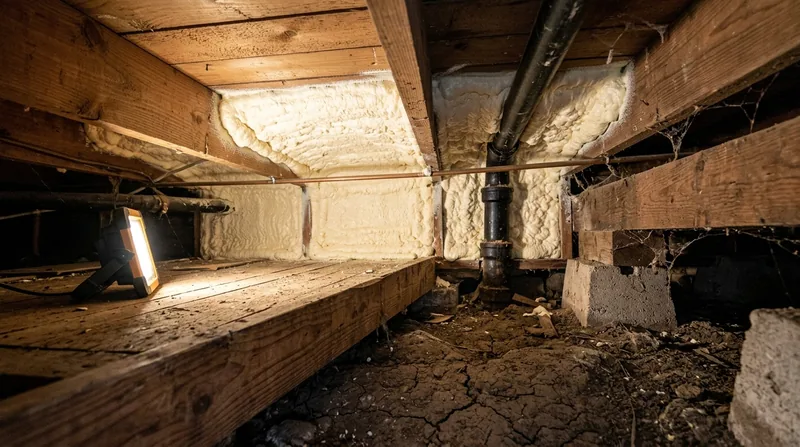




Crawl Space Spray Foam Insulation in Fort Worth stops cold floors in winter and blocks humid summer air where it matters most: under the house. Fort Worth's historic neighborhoods, from Fairmount to Ryan Place to Arlington Heights, sit on pier-and-beam foundations with open crawl spaces that sweat in summer and freeze in winter. The concrete slab homes that fill Wedgwood, Ridglea, and the 1950s ranch belt have their own challenges, but the bungalows and foursquares raised on wooden posts over bare earth face the hardest battle: unconditioned air flowing through rim joists and band joists, cold floors in a freeze, and moisture that never stops. Closed-cell foam seals that space and holds back the weather. We spray it right, with proper moisture control first, or we walk away.
Why Crawl Space Insulation Matters in Fort Worth's Pier-and-Beam Homes
Fort Worth's oldest and most character-rich homes sit on pier-and-beam foundations, leaving a vented crawl space between the wooden subfloor and the earth. That space breathes with the seasons: hot, humid air in summer; freezing air in winter. Energy loss through the floor is real, cold floors are uncomfortable, and moisture creeps into rim joists and band joists where wood rot waits. The cost of doing nothing compounds year after year. Closed-cell spray foam stops the air leakage, insulates the subfloor, and creates a moisture barrier that protects the structure.
- We seal the rim joist and band joist with closed-cell foam to stop air infiltration where it enters the house.
- We insulate the subfloor itself so cold earth does not pull heat through the wooden structure above.
- We address moisture and drainage before spraying, because wet crawl spaces do not get foam until they are dry.
- We specify R-value and thickness on the estimate so you know exactly what you are paying for.
Getting the crawl space right means lower utility bills, warmer floors, and a house that does not sweat in summer.
Local example: A 1920s Craftsman bungalow in Arlington Heights with a 1,200-square-foot crawl space under a 1,600-square-foot footprint lost 18 to 22 percent of its heating to the uninsulated subfloor. After closed-cell foam on the rim joist and 2 inches of closed-cell on the subfloor, the homeowner reported warmer floors and a 14 percent reduction in winter heating load within the first season.
For more on how insulation seals air leakage throughout the house, see our air sealing service page.
Texas law governs contractor registration at the municipal level, not the state. If you are in Fort Worth, Arlington, Keller, or any other city in our service area, ask any contractor for proof of registration with that city before work begins. The City of Fort Worth does require contractor registration; verify the details with the Fort Worth Building Permits and Inspections office at (817) 392-8800 or online at fortworthtexas.gov.
How We Insulate Crawl Spaces: Moisture First, Then Foam
Crawl space insulation is not complicated, but it is done wrong often enough that the right way stands out. We start with a site visit to assess moisture, drainage, and access. If water is sitting or the earth is wet, we address that first. Once the crawl space is dry, we spray closed-cell foam on the rim and band joists, then on the subfloor itself. Thickness and R-value are specified on the estimate and marked on the work so there is no guesswork when the job is done.
- We inspect the crawl space for standing water, drainage problems, and structural damage before quoting.
- We address moisture and drainage issues ourselves or refer you to the right specialist if the work is outside our scope.
- We spray closed-cell foam on the rim and band joists first, creating an air seal where the house meets the foundation.
- We apply foam to the subfloor at the thickness and R-value specified on your estimate.
- We ventilate mechanically during cure and observe a 24- to 48-hour re-entry window before normal use.
The result is a sealed, insulated crawl space that holds conditioned air in and outside air out.
Real example: A 1950s ranch in Hurst with a vented crawl space and standing water after heavy rain needed drainage work before foam. We coordinated with a drainage contractor, then returned to spray 2 inches of closed-cell on the rim joist and 1.5 inches on the subfloor. Total time on site: two days. The homeowner got a written estimate with R-value and thickness before work began.
See our closed-cell spray foam service page for more on why closed-cell is the right choice for crawl spaces.
Crawl Space Insulation Methods and Approaches
| Approach | Description | Best For |
|---|---|---|
| Closed-Cell Rim and Subfloor | 2 to 3 inches of closed-cell foam sprayed on rim joist, band joist, and subfloor. High R-value per inch, creates continuous air seal, moisture barrier. | Pier-and-beam homes in Fort Worth, especially older stock where air leakage and cold floors are the main issues. |
| Closed-Cell Rim Joist Only | Foam applied only to the rim and band joist, not the subfloor. Stops air infiltration at the perimeter, lower cost than full subfloor coverage. | Homes where the subfloor is already insulated or where the primary goal is sealing the rim joist air leak. |
| Moisture Control First | Drainage work, grading, or sump installation completed before any foam is sprayed. Ensures the substrate is dry. | Crawl spaces with standing water, poor drainage, or high water tables. We do not spray over wet conditions. |
| Sealed Crawl Space with Vapor Barrier | Closed-cell foam on rim joist and subfloor, combined with a ground vapor barrier to control earth moisture. | Crawl spaces where humidity control is critical and the goal is a fully conditioned, sealed space. |
Crawl Space Spray Foam Insulation Cost in Fort Worth: What to Expect
Crawl space insulation cost depends on the size of the crawl space, access, moisture conditions, and the thickness of foam you choose. A typical job in Fort Worth starts at $2,500 for a small to medium crawl space with rim joist and partial subfloor coverage. Larger homes, complex drainage, or full subfloor coverage run higher. We provide written estimates with R-value and thickness specified so you know exactly what the cost covers. Get 2 to 3 estimates before you decide, and ask each contractor for the same specifications so you can compare apples to apples.
- Crawl space size is the primary cost driver: a 500-square-foot space costs less than a 2,000-square-foot space.
- Moisture work, if needed, is priced separately and must be done before foam is applied.
- Thickness and R-value are specified on the estimate so cost and performance are transparent.
- Access and obstructions (HVAC ducts, water lines, structural posts) affect labor time and price.
For a detailed pricing overview across all our services, visit our pricing page.
Crawl Space Spray Foam Insulation Near Me: What Fort Worth Homeowners Should Know Before Hiring
Hiring the right spray foam contractor matters. The work is fast, the product is effective, but poor execution leaves you with smell, incomplete coverage, or a bill that does not match the work. Ask any contractor in Fort Worth, Keller, Southlake, Grapevine, or elsewhere in our service area for proof of insurance, references from recent jobs, and a written estimate with R-value and thickness. Ask about their process for moisture control, mechanical ventilation during cure, and the re-entry window they guarantee. Check with the local building department to confirm any registration requirements for your city.
- Confirm the contractor is fully insured and ask to see the certificate of insurance before work begins.
- Request written estimates from 2 to 3 contractors with the same specifications so you can compare costs fairly.
- Ask for references from crawl space jobs completed in the last 12 months and call them.
- Verify that the contractor has a process for addressing moisture before spraying, not after.
- Confirm the re-entry window and mechanical ventilation plan during cure so you understand the timeline.
- Ask whether the contractor works with your city's building department and can help navigate any permits or inspections required at your address.
We are fully insured, have been in business since 2012, and provide written estimates with R-value and thickness on every job. Call us at (817) 607-8986 for a free estimate, or visit our contact page to request one online.
Crawl Space Spray Foam Insulation in Fort Worth: Pricing Guide
| Service | Price | Details |
|---|---|---|
| Rim Joist and Band Joist Sealing | Starting at $2,500 | Closed-cell foam on rim and band joist only, typical for homes where subfloor insulation already exists or is not needed |
| Rim Joist Plus Partial Subfloor Coverage | Starting at $3,500 | Closed-cell foam on rim joist and 50 percent subfloor coverage, sized for medium crawl spaces in Fort Worth and surrounding areas |
| Full Subfloor and Rim Joist Insulation | Starting at $5,500 | Complete closed-cell coverage of rim joist, band joist, and entire subfloor, best for large or complex crawl spaces with full conditioning goals |
| Moisture Control and Drainage Work | On estimate | Grading, drainage correction, or sump installation required before foam can be applied, pricing depends on scope and site conditions |
| Free Written Estimate | No charge | Includes site inspection, R-value and thickness specification, and response within 24 hours at (817) 607-8986 |
Indicative pricing, the exact cost depends on square footage, finish, and site access. Free personalized estimate within 24h at (817) 607-8986.


