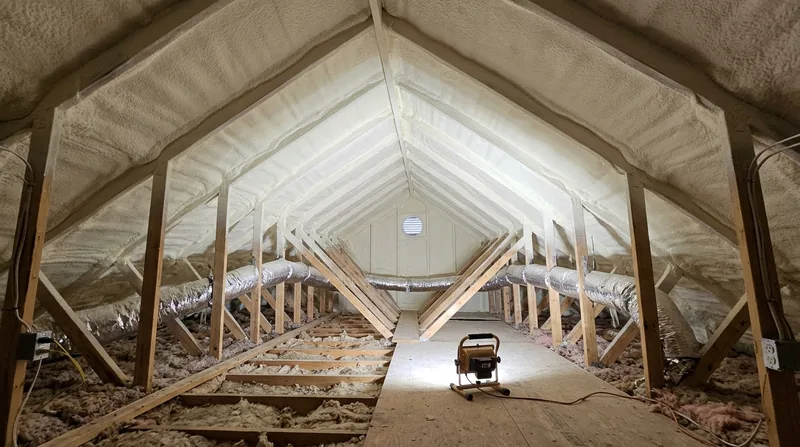




Attic spray foam insulation in Fort Worth transforms a 140-160-degree furnace into conditioned space. North Texas sits on expansive clay, and homes across Fort Worth, Arlington, Keller, and Southlake run ductwork and water lines through vented attics that leak heat and cool air year-round. Winter Storm Uri in 2021 froze attic water lines across the Metroplex, and every spring, hail replacement cycles open thousands of roof decks for retrofit. Open-cell foam on the deck seals the attic envelope, moves ductwork and plumbing inside the thermal boundary, and cuts the load on your air conditioning system. Every estimate lists the R-value, thickness per pass, and board footage so you know exactly what you are paying for.
Why Attic Spray Foam Insulation Matters in Fort Worth's Climate
Fort Worth summers push 100 degrees for weeks at a time, and attic temperatures climb past 150 degrees under a Texas sun. Fiberglass batts and blown-in cellulose compress, settle, and leave gaps around joists, ductwork, and electrical boxes. The result is conditioned air leaking into an unconditioned space, and your cooling system running constant. Spray foam seals the entire roof deck, every penetration, and every corner in a single continuous layer. The foam cures to a solid barrier that does not settle, compress, or lose contact with the substrate. In a climate where summer cooling demand runs nine months a year, that seal pays itself back in lower bills and equipment runtime.
- Open-cell foam at R-3.6 per inch turns a vented attic into an unvented, conditioned space.
- Every penetration, duct, and water line ends up inside the envelope, eliminating the freeze risk that Winter Storm Uri exposed.
- The foam cures in place and does not settle, compress, or develop thermal gaps over time.
- Sealing the roof deck drops attic temperature by 30 to 40 degrees on a summer afternoon.
- Lower attic temperature means lower cooling load, lower equipment runtime, and lower electricity bills.
Spray foam insulation is the permanent answer to the thermal leak that fiberglass and cellulose cannot stop.
Key info: Fort Worth homes built 1950s through 1970s often have empty wall cavities and flattened original attic fill. Wedgwood, Ridglea, Haltom City, and North Richland Hills ran brick ranches with minimal insulation, and many still do. An attic retrofit with open-cell foam transforms the entire thermal performance of the house without touching the walls or the roof structure.
For more on how foam handles the North Texas heat, see our guide to open-cell spray foam insulation in Fort Worth.
How We Install Attic Spray Foam Insulation in Fort Worth
Every job starts with a site inspection. We measure the attic, identify the roof deck, check for moisture, active leaks, or contamination, and confirm the substrate is dry and ready. We then calculate the square footage, determine the R-value and thickness per pass, and provide a written estimate with all three figures. Once you approve, we schedule the work, bring in our spray rig, set up mechanical ventilation, and spray the foam in controlled passes. The foam cures in 24 to 48 hours, and we provide a re-entry window so you know when the space is safe to access.
- We inspect the attic and confirm the roof deck is dry and free of active leaks before any foam is applied.
- We calculate R-value, thickness per pass, and board footage and provide all three in writing before work begins.
- We install mechanical ventilation during cure to manage off-gassing and ensure proper curing conditions.
- We spray in controlled passes, allowing each pass to tack before applying the next, so thickness and coverage are uniform.
- We provide a clear re-entry window of 24 to 48 hours and explain what to expect during cure.
This step-by-step approach means no surprises, no hidden costs, and a finished attic you can count on.
Example: A 1970s ranch in Wedgwood with 1,200 square feet of attic space and existing blown-in cellulose receives 5.5 inches of open-cell foam at R-3.6 per inch, yielding R-19.8. The job takes one day, the foam cures overnight, and the homeowner sees lower cooling bills within the first month of summer.
If your attic has failed or settling insulation, see our insulation removal and replacement service for the complete retrofit.
Attic Spray Foam Insulation Methods and Approaches
| Approach | Description | Best for |
|---|---|---|
| Open-Cell Spray Foam | Low-density foam at R-3.6 per inch, softer and slightly flexible when cured. Excellent sound dampening and air sealing. Absorbs water if exposed to moisture. | Dry attics, sealed roof decks, sound control, and Fort Worth's high cooling load demand. |
| Closed-Cell Spray Foam | High-density foam at R-6.5 to R-7 per inch, rigid when cured. Impermeable to water and vapor. Smaller board feet required for same R-value. | Moisture-prone attics, metal buildings, condensation control, or where space is tight and R-value must be high. |
| Top-Up or Partial Retrofit | Spray foam applied over existing sound insulation to add R-value and seal air leaks without full removal. | Attics with settled but non-contaminated fiberglass or cellulose where budget or time favors a partial upgrade. |
| Full Removal and Replacement | Old or failed insulation removed, attic cleaned, substrate inspected and dried, then new spray foam applied to design R-value. | Attics with compression, moisture damage, settling, or contaminated insulation requiring a complete thermal reset. |
Attic Spray Foam Insulation Cost in Fort Worth: What to Expect
Attic spray foam insulation in Fort Worth starts at approximately $1.50 per square foot for open-cell foam on a straightforward retrofit of a dry attic with good access. The final price depends on attic size, the R-value you choose, the existing insulation (if any), roof deck condition, access difficulty, and whether removal work is required. A typical 1,200-square-foot attic retrofit runs $1,800 to $3,600 for open-cell foam at R-19 to R-24. Closed-cell foam costs more per board foot but requires fewer inches to reach the same R-value, so the total can be comparable depending on your target. Always get two or three written estimates that include square footage, R-value, thickness per pass, and board footage so you can compare apples to apples.
Factors that move the price up or down include the following:
- Attic size: larger attics spread the mobilization cost over more square feet, lowering the per-square-foot rate.
- Existing insulation: if blown-in cellulose or fiberglass must be removed first, add $0.30 to $0.60 per square foot for removal and disposal.
- Roof deck condition: leaks, moisture, or contamination require repair or drying before foam is applied, adding cost and time.
- Access: attics with low headroom, tight hatches, or ductwork congestion require more setup time and labor.
- R-value target: R-19 costs less than R-30, and closed-cell foam costs more per board foot than open-cell, though it achieves higher R-value in fewer inches.
See our complete pricing guide for detailed ranges and what drives cost in your specific situation. Call us at (817) 607-8986 for a free written estimate with no obligation.
Attic Spray Foam Insulation Near Me: What Fort Worth Homeowners Should Know When Hiring
Spray foam insulation is not licensed at the state level in Texas, but contractor registration requirements vary by city. Fort Worth, Arlington, Keller, Southlake, and other municipalities may require contractors to register before pulling permits or performing work. Before you hire any spray foam contractor, ask to see their municipal registration for your city and confirm it with your local building department. Fully insured status is essential, and you should ask for a certificate of insurance and verify coverage limits. Get at least two written estimates that specify R-value, thickness per pass, and board footage. Check references and ask whether the contractor has experience with your attic size and existing insulation type. If your home is in an HOA, confirm that exterior work or roof access does not trigger architectural review. Always ask about permits and whether they apply to your address, because permit requirements differ between cities.
- Ask any contractor for proof of municipal registration if your city requires it, and verify it with your building department before work begins.
- Request a certificate of insurance and confirm that coverage includes spray foam application and general liability.
- Get written estimates from at least two contractors, all with R-value, thickness per pass, and board footage clearly stated.
- Ask for references from recent attic jobs in Fort Worth or your specific neighborhood.
- Understand whether your city requires a permit for attic insulation work, and if so, who pulls it and whether it affects the timeline or cost.
- If you live in a master-planned community, check your HOA rules for roof access or exterior work restrictions before scheduling.
A reputable contractor will answer every question, provide written estimates with all specs, and explain exactly what happens before, during, and after the work. For a free estimate and to discuss your attic's specific needs, contact us today.
For more on what to look for in any spray foam contractor, the State of Texas does not license insulation work at the state level, but the City of Fort Worth Building Services administers contractor registration and permitting for work within city limits. Check your local city website for registration requirements that apply to your address.
Attic Spray Foam Insulation in Fort Worth: Pricing Guide
| Service | Price | Details |
|---|---|---|
| Open-Cell Spray Foam Attic Retrofit | Starting at $1.50/sq ft | Dry attic, good access, R-19 to R-24 coverage, includes mechanical ventilation during cure |
| Closed-Cell Spray Foam Attic Retrofit | Starting at $2.25/sq ft | High R-value per inch, moisture control, condensation prevention, condensing attics or metal buildings |
| Removal and Full Replacement | Starting at $2.00/sq ft | Failed or settling insulation removed, attic cleaned and inspected, new foam applied to design R-value |
| Top-Up or Partial Retrofit | Starting at $1.25/sq ft | Foam applied over existing sound insulation to add R-value and seal air leaks without full removal |
| Travel and Mobilization | Included | No separate charge for service calls or travel within Fort Worth and surrounding service area cities |
| Free Written Estimate | No Charge | Complete site inspection, R-value and thickness specs, board footage, and pricing breakdown with no obligation |
Indicative pricing, the exact cost depends on square footage, finish, and site access. Free personalized estimate within 24h at (817) 607-8986.


