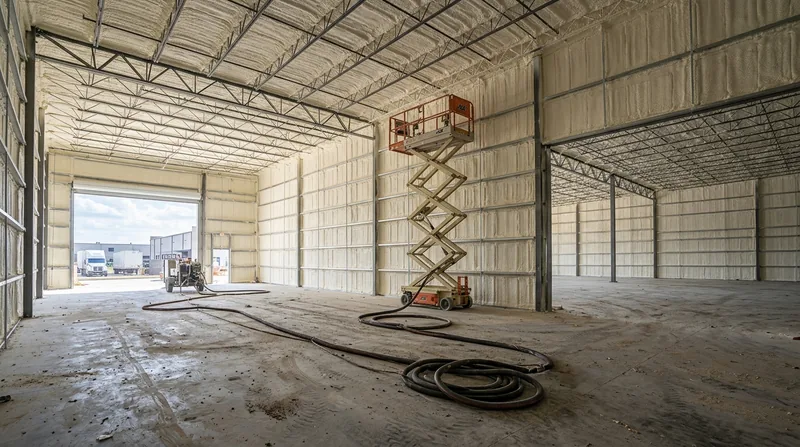




Commercial and new construction spray foam insulation in Fort Worth demands a contractor who understands the scale, timeline, and code compliance that builders and property managers require. The Fort Worth commercial corridor runs from AllianceTexas through Arlington and Grand Prairie to the airport belt, where warehouses, offices, churches, and production facilities rise on demanding schedules. These buildings need thermal control that works on day one, documentation that passes inspection, and crews who can phase work without shutting down your operation. Spray foam delivers all three, but only when installed by a crew that knows the code, respects the clock, and shows up with the paperwork your inspector will actually accept.
Why Commercial Spray Foam Insulation Matters in Fort Worth's Building Boom
Fort Worth's commercial real estate market runs year-round, and the buildings that move fastest are the ones that meet code on the first inspection and stay on budget. Spray foam insulation solves the three problems that slow commercial projects: thermal bridging that kills HVAC efficiency, air leakage that bleeds conditioned air, and moisture intrusion that corrodes steel and rots wood. Unlike fiberglass batts or blown-in cellulose, spray foam seals the entire envelope in a single pass, leaving no gaps for the inspector to flag. On a warehouse shell in Arlington or a production facility in Grand Prairie, that means one less reason for the GC to call you back, and one less delay on the critical path.
- We seal thermal bridging at the rim joist, the band board, and the perimeter where the slab meets the wall, cutting heat loss that HVAC equipment cannot overcome.
- We document thickness and R-value on every section, giving your building inspector the hard data the energy code requires.
- We work phased: spray the roof deck and walls first, then the floor system, without stopping your operation or blocking dock access.
- We remove failed or outdated insulation and replace it with code-compliant foam, so renovation projects stay on schedule and within the energy standard in force at your address.
Code-compliant assemblies with full documentation are the only way to avoid re-inspection delays and change orders that crater the budget.
Key info: The City of Fort Worth, the City of Arlington, and the City of Grand Prairie each enforce the current International Energy Conservation Code (IECC), and the thermal barrier and ignition barrier requirements differ based on the foam type and the building assembly. Your local building official has the final say, not the foam manufacturer. We help you navigate what applies at your address, and we deliver the documentation that satisfies your inspector on the first pass.
For more detail on how we approach commercial and new construction projects, see our closed cell spray foam page, which covers the high-performance insulation most warehouses and metal buildings require.
How We Install Commercial Spray Foam on Schedule and to Code
Commercial spray foam installation is a choreographed process. We arrive with the equipment, the material, and the crew sized to your project timeline. We inspect the substrate, verify that it is dry and sound, and lay out the spray sequence so that you know exactly when each zone will be shut down and how long it will take to cure. Mechanical ventilation during application keeps the workspace safe, and we enforce a re-entry window of twenty-four to forty-eight hours before you can occupy or load the space. On a large facility, we can phase the work across multiple days, spraying one wing while another remains operational. Your GC knows the schedule, your inspector knows what to expect, and the building stays on track.
- We conduct a pre-spray walkthrough with your project manager to confirm access, substrate condition, and the exact zones to be treated.
- We set up mechanical ventilation and establish a perimeter to control overspray and protect adjacent areas from off-gassing.
- We spray the foam in controlled passes, measuring thickness with a gauge and documenting R-value for each section.
- We apply thermal and ignition barriers as required by the energy and building code in force at your address.
- We provide a signed, dated inspection report and photographic documentation so your building official has everything needed to sign off.
The entire process, from first estimate to final sign-off, is built around keeping your project on the critical path and your inspector satisfied.
Local example: A production facility in Mansfield needed to insulate a 40,000-square-foot warehouse addition before equipment installation in six weeks. We phased the work across two weeks, spraying the roof deck and walls without shutting down the existing operation, and delivered full documentation to the city inspector within three days of completion. The GC stayed on schedule, and the final inspection passed without callbacks.
For detail on our air sealing practices and how they complement spray foam, visit our air sealing page.
Spray Foam Installation Methods for Commercial and New Construction
| Approach | Description | Best for |
|---|---|---|
| Closed Cell Spray Foam | High-density foam (3.5 to 4.5 lb/cu ft) with an R-value of 6.0 to 6.5 per inch. Provides superior moisture and air barrier properties. Slower cure time than open cell. | Metal buildings, unvented attics, roof decks, and any application where moisture control or structural rigidity is critical. |
| Open Cell Spray Foam | Lower-density foam (0.4 to 0.5 lb/cu ft) with an R-value of 3.5 to 3.8 per inch. Fast cure, flexible, and cost-effective. Allows vapor diffusion. | Interior walls, vented attics, and applications where cost and sound dampening are priorities and moisture risk is low. |
| Rim and Band Joist Foam | Closed cell foam applied to the perimeter rim joist and band board where the slab or pier-and-beam meets the wall. Blocks thermal bridging and air leakage at the foundation. | Warehouse foundations, office buildings, and any structure where the perimeter represents a significant thermal loss point. |
| Insulation Removal and Replacement | Complete removal of failed or outdated insulation, substrate preparation, and installation of new spray foam. Includes disposal and site cleanup. | Renovation and retrofit projects where existing insulation is damaged, settling, or does not meet the current energy code. |
Commercial and New Construction Spray Foam Cost in Fort Worth: What to Expect
Commercial spray foam pricing in Fort Worth depends on the scope of work, the foam type, the building size, and the complexity of the assembly. A free commercial estimate is the only honest starting point, because the factors that move the cost are site-specific: the total square footage, the R-value target, whether you are spraying a new shell or retrofitting an existing structure, and how the work is phased around your operation. A warehouse roof deck in Fort Worth might run one price per board foot, while a retrofit of an occupied office building in Arlington might run another because of staging and access constraints. The key is to get two or three estimates from contractors who provide written specifications with R-value and thickness for every section, so you can compare apples to apples and avoid the low bid that cuts corners on documentation or cure time.
We provide a detailed pricing overview for all our services, and we welcome a call at (817) 607-8986 to discuss your specific project and timeline. For a full commercial estimate with no obligation, contact us and we will respond within 24 hours.
Commercial and New Construction Spray Foam Contractors Near Me: What to Look For
Hiring the right spray foam contractor is as important as the material itself. Texas regulates contractors at the municipal level, not the state level, which means the City of Fort Worth, the City of Arlington, the City of Grapevine, and other cities in the metroplex each have their own registration and permitting requirements. Before you sign a contract, ask any contractor whether they are registered with your city and verify it directly with the city building department. You should also confirm that they carry full insurance and can provide a certificate of insurance on request. Look for a contractor who provides a written estimate with R-value and thickness specifications for every section, who explains the code requirements that apply at your address, and who commits to mechanical ventilation during application and a stated re-entry window. Avoid any contractor who promises immediate occupancy, who quotes a price with no specification attached, or who cannot provide references from recent commercial or new construction projects.
- Verify that the contractor is registered with your city as a contractor before any work begins, and confirm the registration directly with the city building department.
- Request a certificate of insurance and confirm that the coverage is current and adequate for the scope of your project.
- Ask for at least two references from commercial or new construction projects completed in the past two years.
- Require a written estimate that includes R-value, thickness, foam type, and the code or standard that governs the assembly.
- Confirm that the contractor will provide mechanical ventilation during application and will state a re-entry window of twenty-four to forty-eight hours before you can occupy the space.
A professional spray foam contractor will welcome these questions and will have the answers ready.
For more guidance on finding and vetting a spray foam contractor in your area, get in touch with us or call (817) 607-8986 to discuss your project.
Commercial & New Construction Spray Foam in Fort Worth: Pricing Guide
| Service | Price | Details |
|---|---|---|
| Free commercial estimate | Free | Includes site walkthrough, code review, and written specification with R-value and thickness for each zone |
| Closed cell spray foam (new construction or retrofit) | Starting at $2.50 per board foot | Varies by R-value target, building size, and whether work is phased around ongoing operations |
| Open cell spray foam (interior walls, vented spaces) | Starting at $1.10 per board foot | Lower cost option for applications where moisture control is not critical and thermal performance targets are moderate |
| Insulation removal and replacement | On estimate | Depends on the volume of existing material, substrate condition, and whether hazardous materials testing is required before removal |
| Travel and mobilization | Included | No separate mileage fee or travel charge within Fort Worth and surrounding service areas |
| Estimate turnaround | 24 hours | Response to your inquiry within one business day, with no obligation to book or sign a contract |
Indicative pricing, the exact cost depends on square footage, finish, and site access. Free personalized estimate within 24h at (817) 607-8986.


