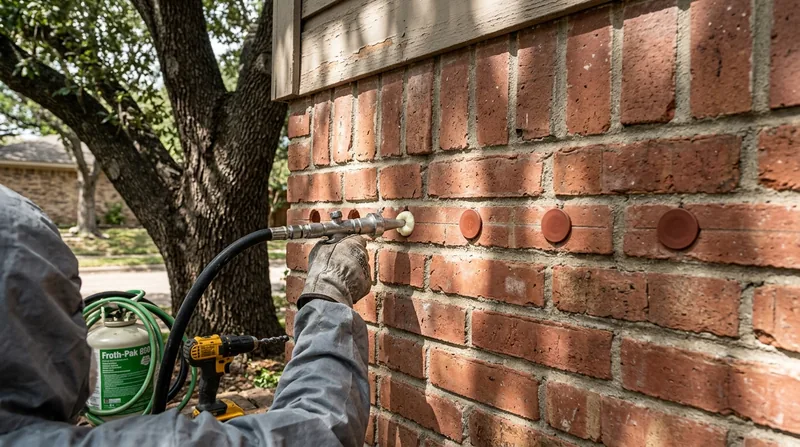




Wall and injection foam insulation in Fort Worth fills empty cavities in closed walls without tearing out drywall or siding, making it the retrofit answer for tens of thousands of homes across the Metroplex. Fort Worth's signature housing stock, 1950s and 1960s ranches with brick or stone veneer over hollow stud cavities, and older Craftsman bungalows with wood siding and no insulation behind the walls, sits in the path of North Texas summers that routinely push 100 degrees for weeks at a time. Those empty cavities leak conditioned air and radiant heat straight through the exterior skin, forcing air conditioning systems to run constantly and driving utility bills higher than they should be. Injection foam seals those voids from the inside, adds R-value where it matters most, and leaves no visible trace on the outside. The ports are small, drilled through the veneer or siding, sealed with matching caulk or patch, and the work is done in a day or two without scaffolding or demolition. For homeowners in Wedgwood, Ridglea, Arlington Heights, and the 1950s-70s belt around Hurst and North Richland Hills, it is often the only practical way to insulate a wall cavity that was never filled in the first place.
Why Wall and Injection Foam Insulation Matters in Fort Worth's Climate
Fort Worth sits on the rolling Grand Prairie with expansive clay soils and a climate that demands thermal control on all four sides of a house. Summer heat radiates through uninsulated exterior walls from sunrise to sunset, and the brick or stone veneer that makes those homes beautiful is also a thermal conductor that transfers that heat straight into the living space. Winter brings occasional freezes that can last several days, and the dry continental air means any infiltration through wall cavities is felt immediately. An empty wall cavity is not neutral; it is actively working against your comfort and your wallet.
- Injection foam fills voids completely, eliminating the convection currents that move air through empty cavities and defeat fiberglass batts.
- The process requires no interior demolition and leaves the exterior appearance unchanged, which matters on homes with historic character or strict HOA rules.
- Closed-cell foam in walls provides both insulation and air sealing in a single step, reducing the load on air conditioning and heating systems.
- The work is fast, typically one to two days for a full house, and the home is reoccupied immediately after cure.
Homeowners who insulate empty walls often see meaningful reductions in utility bills and notice that rooms feel more stable in temperature, especially the south and west-facing sides of the house that catch afternoon sun.
Key info: A 1,500-square-foot ranch in Wedgwood with uninsulated exterior walls over a vented attic can lose 30 to 40 percent of conditioned air through infiltration and conduction. Injection foam in the walls, combined with sealed attic work, is often the fastest path to comfort and lower energy use without a major renovation.
For more context on how exterior insulation fits into a whole-home approach, see our page on attic spray foam insulation in Fort Worth, which is often paired with wall work for maximum effect.
How We Inject Foam Into Walls: The Process in Fort Worth
Injection foam insulation is a controlled, measured process that starts with a site walk and a clear scope. We identify the wall cavities that are empty, determine the best port locations (usually along the rim or at regular intervals), and drill small holes through the veneer or siding. The foam is then injected at a controlled rate, filling the cavity from bottom to top and allowing it to expand and cure. Once cured, the ports are sealed with caulk or patched to match the exterior, and the work is complete. The entire process is clean, contained, and leaves no mess inside the home.
- We survey the wall cavity depth and width to calculate the volume and R-value needed for that section.
- Ports are drilled at measured intervals, typically 16 to 24 inches apart depending on cavity width and foam type.
- Closed-cell foam is injected slowly to ensure complete fill without excessive pressure that could bow studs or crack veneer.
- Mechanical ventilation runs during and after injection to manage cure fumes, and the home is occupied only after the stated re-entry window (typically 24 to 48 hours).
- All port holes are sealed with paintable caulk on brick or stone, or with color-matched sealant on siding, so no evidence of the work remains.
The result is a wall cavity that is fully insulated, air-sealed, and ready to perform for the life of the home.
Example: A Colleyville homeowner with a 1960s brick ranch and hollow walls on the south face had injection foam applied to the exterior wall cavities facing the afternoon sun. The ports were drilled through the brick mortar joints, filled with closed-cell foam, and sealed with color-matched caulk. Three weeks later, the homeowner reported that the bedroom on that side no longer felt hot in the afternoon and that the air conditioning ran less frequently during the peak heat of summer.
To understand how wall insulation complements other air sealing work, review our air sealing services in Fort Worth.
Injection Foam Methods: Closed-Cell vs. Open-Cell in Fort Worth Walls
| Approach | Description | Best for |
|---|---|---|
| Closed-cell injection foam | High-density foam with closed cells that provide air sealing and moisture resistance. Typical R-value 6 to 7 per inch. Slower cure, controlled application, mechanical ventilation required during and after spray. | Standard choice for exterior walls in Fort Worth, especially on south and west faces where heat load and infiltration are highest. Provides both insulation and air barrier. |
| Open-cell injection foam | Lower-density foam with open cells that allow some vapor transmission. Typical R-value 3.5 to 4 per inch. Faster cure, lighter feel, lower material cost, but does not provide air sealing on its own. | Interior wall cavities in climate-controlled spaces where vapor management is important and R-value per inch is less critical. Less common for exterior walls in North Texas. |
| Partial fill with batt backup | Injection foam fills the cavity partially, then fiberglass batts are added to reach target R-value. Balances cost and performance, especially in deeper cavities. | Large-scale retrofit projects where budget is a concern but air sealing at the rim and rim cavities is the priority. |
| Full-depth closed-cell | Closed-cell foam injected to fill the entire cavity depth, typically 3.5 to 5.5 inches in standard 2x4 or 2x6 walls. Highest R-value and complete air sealing in one application. | Premium retrofit on high-performance homes or where maximum R-value and air sealing are non-negotiable, such as homes with radiant heating or sensitive HVAC zones. |
Closed-cell foam is the standard for Fort Worth wall injection work because it delivers both R-value and air sealing, and the North Texas climate demands both. Open-cell is rarely used in exterior walls here because the summer heat load and winter infiltration risk make the air barrier function essential.
Wall and Injection Foam Insulation Cost in Fort Worth: What to Expect
Wall injection foam in Fort Worth typically starts at $2 to $4 per square foot of wall area, depending on the cavity depth, foam type, and accessibility of the ports. A typical 1,500-square-foot ranch with exterior walls averaging 8 feet tall and roughly 400 to 500 linear feet of perimeter will fall in the $3,000 to $6,000 range for full closed-cell injection on all exterior walls. Costs move up if cavities are deeper (2x6 studs instead of 2x4), if the veneer is stone or specialty brick that requires careful drilling, or if access is difficult due to landscaping or proximity to neighboring homes.
- Cavity depth is the single largest cost driver; 2x4 walls cost less than 2x6 walls because they hold less foam.
- Veneer type matters; drilling through standard brick is straightforward, but stone, cultured stone, or decorative bond patterns require more care and time.
- Linear footage of wall to be filled determines total material and labor; a partial retrofit (one or two sides) costs less than a full wrap.
- Access and obstructions (fences, landscaping, parked vehicles) can add time and affect the final price.
- Mechanical ventilation setup and cure time add to labor cost but are non-negotiable for safety and code compliance.
The best way to arrive at a firm number is a free, no-obligation site estimate. We measure the walls, identify the cavities, and provide a written scope with R-value and thickness specifications so you know exactly what you are paying for. For more detail on pricing across all our services, visit our pricing overview page.
Wall and Injection Foam Insulation Near Me: What Fort Worth Homeowners Should Know When Hiring
Hiring the right spray foam contractor is critical because the installation quality determines whether the foam performs as designed and whether the home is safe to occupy during cure. Ask any contractor you are considering for proof of full insurance coverage, and verify it with their carrier before work begins. Request written estimates from at least two other contractors so you can compare scope, R-value, thickness, and price; a lowball estimate with vague specs is a red flag. Ask for references from recent jobs in your neighborhood and call at least two of them. Understand what permits your city requires for the work and confirm that the contractor will help you navigate the local process; permitting varies from city to city across Greater Fort Worth, and there is no reciprocity between them, so it matters that your contractor knows your specific city's rules.
- Verify that the contractor's insurance covers spray foam work and that the certificate lists injection and closed-cell foam specifically.
- Ask whether the estimate includes a re-entry window and what that means for your family and pets during cure.
- Confirm that mechanical ventilation will run during and after the spray, and ask how long the home will need to be ventilated before re-entry.
- Check whether your HOA has architectural rules that govern exterior work, especially if your home is in a master-planned area like Southlake or Colleyville.
- Ask the contractor to walk you through the port drilling process and how the patches will be finished so you understand what to expect on the exterior.
A contractor who takes time to explain the work, provides a detailed written estimate, and can answer your questions about safety and cure is the one worth hiring. If you are ready to move forward, contact us for a free estimate and we will walk you through the entire process.
Wall & Injection Foam Insulation in Fort Worth: Pricing Guide
| Service | Price | Details |
|---|---|---|
| Closed-cell injection foam, standard 2x4 walls | Starting at $2/sq ft | Full cavity fill on exterior walls, includes port drilling, foam injection, and seal-and-patch on brick or siding veneer |
| Closed-cell injection foam, deeper 2x6 walls | Starting at $3/sq ft | Greater foam volume and longer injection time per cavity; stone or specialty brick veneer adds to drilling complexity |
| Partial retrofit, one or two walls only | Starting at $2,500 | South or west-facing exterior walls on ranches and bungalows where heat load is highest; includes setup, ventilation, and full cure |
| Full-home exterior wall injection, typical ranch | On estimate | Site measurement required to determine linear footage, cavity depth, veneer type, and accessibility; written estimate includes R-value and thickness |
| Travel and mobilization | Included | No separate charge for Fort Worth and surrounding service areas within the Metroplex |
| Free estimate | No charge | Response within 24 hours, (817) 607-8986, written scope with R-value and thickness specifications included |
Indicative pricing, the exact cost depends on square footage, finish, and site access. Free personalized estimate within 24h at (817) 607-8986.


